

A stage electric chain hoist is only one part of a professional lifting system. To operate safely, smoothly, and efficiently, every hoist needs the right controller. For theaters, concert venues, broadcast studios, touring productions, nightclubs, exhibitions, and immersive entertainment spaces, the controller determines how many hoists can be operated, how precisely they move, and how easily the rigging team can manage the system during setup or live operation.
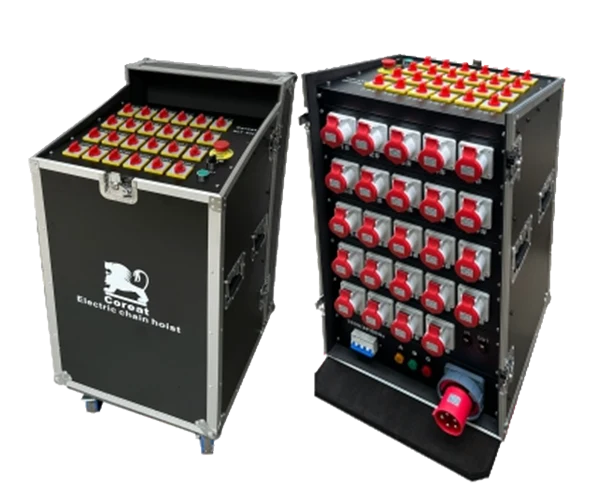
Choosing the right stage hoist controller is not just about the number of channels. It also depends on the application, installation type, operating environment, enclosure style, portability, and future expansion requirements.
This guide explains the key factors to consider before selecting a hoist controller for your project.
What Is a Stage Hoist Controller?
A stage hoist controller is the control unit used to operate one or more electric chain hoists. It allows operators to lift, lower, stop, and synchronize hoists according to the needs of the production or venue.
In a simple fixed installation, a controller may operate only a few hoists. In a larger touring or venue system, the controller may need to manage multiple hoists at the same time, helping raise lighting trusses, LED screens, speaker arrays, scenic elements, or stage equipment safely and evenly.
Coreat’s KLT controller range is designed to work with professional stage electric chain hoists, including fixed installation hoists and touring hoist systems.
1. Start With the Number of Hoists You Need to Control
The first question is simple: how many hoists will the controller operate?
For smaller venues or compact rigging systems, a 4-channel controller is often enough. This type of controller is suitable for hotel ballrooms, small theaters, compact event setups, and simple fixed installations.
For medium-sized productions, an 8-channel controller is more flexible. It can handle larger lighting trusses, small touring rigs, broadcast studio grids, and venue systems where several hoists need to move together.
For larger event setups, 12-channel or 24-channel controllers provide higher capacity. These are more suitable for concert touring, exhibition builds, large venues, and complex stage systems where many hoists need coordinated operation.
As a general rule, it is better to choose a controller with some extra channel capacity. This gives the rigging team room to expand the system later without replacing the entire control unit.
2. Choose the Right Controller Format
Stage hoist controllers are available in different physical configurations. The right choice depends on how and where the system will be used.
- Portable waterproof case controllers are practical for touring companies and event teams because they are easy to carry, quick to deploy, and suitable for temporary installations.
- Aviation case controllers provide stronger protection during transport and are ideal for productions that need a road-ready control system.
- 3U rack controllers are better suited for permanent installations, technical racks, and fixed venue systems.
- Mobile cabinet controllers are useful for larger systems that require higher channel capacity and easier on-site positioning.
- Touchscreen controllers provide a more advanced operation interface for multi-hoist environments that need clearer system feedback.
3. Match the Controller to the Application
Different entertainment environments have different control requirements.
For theaters and auditoriums, reliability and repeatability are the top priorities. Hoists may be used to position lighting fixtures, scenic structures, curtains, or stage equipment. A fixed rack or cabinet controller may be the best option for long-term use.
For concert touring, portability is critical. Controllers must be easy to transport, quick to connect, and strong enough to handle repeated setup and teardown. Waterproof case or aviation case controllers are usually preferred.
For broadcast studios, smooth and quiet operation matters. Controllers should support precise lifting of lighting grids and equipment without disrupting production schedules.
For nightclubs and entertainment venues, controllers may be used for LED screens, lighting trusses, or kinetic decorative systems. In these cases, multi-channel control and reliable synchronization are important.
For exhibitions and temporary event builds, flexibility is often the key requirement. A portable controller with enough channels can help teams adapt to different booth layouts and venue conditions.
4. Consider Safety and Synchronization
When multiple hoists lift the same structure, control accuracy becomes especially important. A truss, LED wall, or speaker system must rise evenly to avoid uneven loading and potential safety risks.
A suitable hoist controller helps operators manage multiple hoists from one control point. This improves efficiency and reduces the risk of inconsistent lifting between separate units.
For more advanced systems, especially kinetic installations or automated stage machinery, a more intelligent control system may be required. These applications may need programmable movement, position feedback, and synchronized multi-unit control.
5. Think About Future Expansion
Many venues start with a small hoist system and expand later. A theater may add more lighting positions. A touring company may take on larger productions. A nightclub may upgrade from a static rig to a moving LED system.
For this reason, future expansion should be considered before buying a controller. If your current project needs 4 hoists, an 8-channel controller may offer useful room to grow. If your current setup needs 8 hoists, a 12-channel or 24-channel option may be more cost-effective over time.
6. Work With a Manufacturer That Builds Both Hoists and Controllers
One common problem in stage rigging systems is compatibility. When hoists and controllers come from different suppliers, issues can appear in wiring, control logic, safety functions, or technical support.
Coreat manufactures both stage electric chain hoists and hoist controllers. This helps ensure that the controller and hoist are designed to work together as a complete lifting system.
For buyers, this means simpler configuration, easier troubleshooting, and more reliable support from one engineering team.
Conclusion
A stage hoist controller should be selected with the full lifting system in mind. The right choice depends on the number of hoists, installation type, operating environment, portability needs, safety requirements, and future expansion plans.
Coreat provides stage electric chain hoists and KLT hoist controllers for professional entertainment applications worldwide. Whether you are building a small fixed rig or a multi-hoist venue system, choosing the right controller is the first step toward safer, smoother, and more efficient stage lifting.