

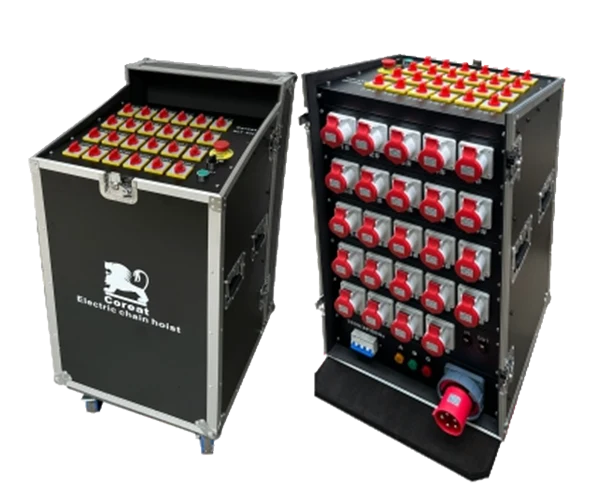
When buyers compare stage hoist controllers, they often start with enclosure style: portable case, rack-mount chassis, or mobile cabinet. But one of the most important technical questions comes even earlier: how many hoists must the controller manage in real operation?
That answer affects not only the controller model, but also power distribution, touring workflow, synchronization, future expansion, and day-to-day operating safety. A four-hoist system for a ballroom or studio is fundamentally different from a twelve-hoist concert touring rig or a twenty-four-hoist permanent venue installation.
Coreat’s KLT stage hoist controller range is designed to match different channel requirements, from compact 4-channel systems to large-format 24-channel control. In this guide, we explain how to choose the right channel count, when to scale up, and how to think about controller architecture before you buy.
What does channel count mean on a stage hoist controller?
In practical terms, a channel is one controllable hoist line. If you need to run four hoists independently or in synchronized movement, you need at least a 4-channel controller. If the system includes eight hoists, twelve hoists, or more, the controller must support that channel count directly or through approved linked expansion.
Channel count should be planned around the actual number of hoists used in the rig, not just the number installed today. Many venues and touring companies discover that the first specification was too small once the production design grows.
When a 4-channel controller is the right choice
A 4-channel controller is usually the best fit for smaller and simpler installations. It works well when the rig only needs a few lifting points and the production team values straightforward setup over large-scale expansion.
Typical 4-channel applications include:
- Small theaters and black box spaces
- Hotel ballrooms and conference venues
- Broadcast or rehearsal studios with compact grids
- Basic scenic lifting or small lighting truss systems
Coreat’s 4-channel controller options are practical when the project needs dependable synchronized operation without the footprint or cost of a larger system. For many entry-level professional venues, this is the logical starting point.
When an 8-channel controller makes more sense
An 8-channel controller is often the most versatile mid-range choice. It gives the production team enough capacity for more ambitious entertainment rigging without immediately moving into large-format system design. This is why 8-channel controllers are so common in concert touring, event production, and mid-size permanent venues.
An 8-channel system is a strong fit for:
- Concert touring truss packages
- Mid-size theater or worship venue installations
- LED wall and speaker support systems
- Studios that regularly reconfigure multiple lifting points
If you are deciding between portable and installed formats, this article on portable vs rack-mount stage hoist controllers is a useful companion resource.
When to move up to a 12-channel controller
Once a project reaches double-digit hoist counts, the control strategy becomes more important. A 12-channel controller is usually selected when the rig is too large for compact touring control but still benefits from centralized operation in one unit.
Common 12-channel use cases include:
- Larger touring productions with multiple trusses
- Broadcast studio ceiling grids with many active points
- Permanent theater systems with more complex overhead layouts
- Entertainment venues that want extra spare capacity for future changes
The main advantage of a 12-channel system is flexibility. It reduces the need to split operation across multiple smaller controllers too early, which helps simplify training, control logic, and setup time.
When a 24-channel controller is the right solution
A 24-channel stage hoist controller is not just a bigger version of a small controller. It is usually part of a larger control philosophy for major venues, arena-scale touring, or permanent installations where many hoists must be organized from one central operating position.
24-channel control is typically specified for:
- Large theaters and opera houses
- Arena and stadium touring productions
- Major broadcast or performance studio grids
- Permanent installations that need centralized control of extensive hoist arrays
At this scale, future expansion, cable management, equipment-room planning, and operator workflow all matter just as much as channel count itself. Buyers should also confirm whether linked controllers or cabinet-based solutions are the better long-term approach.
Portable vs installed controller architecture
Channel count should be evaluated together with installation format.
- Portable controllers are better for touring, temporary events, and mobile production workflows.
- Rack-mount controllers are better for theaters, studios, hotels, and conference centers with fixed equipment infrastructure.
- Mobile cabinet systems are better for large permanent systems or major productions needing many channels in one centralized station.
Coreat’s controller lineup covers each of these formats, which makes it easier to match the control package to the venue or tour instead of forcing one format onto every project.
How to avoid under-specifying channel count
One of the most common buyer mistakes is ordering a controller that matches today’s minimum hoist quantity but leaves no room for future growth. If the venue may add trusses, scenic positions, or new LED structures later, a little spare capacity can prevent expensive replacement later.
Ask these questions before finalizing the controller:
- How many hoists are in the current design?
- Will spare channels be needed for future venue upgrades?
- Will the rig be used in one venue or across many touring projects?
- Does the team prefer one larger controller or multiple linked units?
- Will the system be paired with touring-oriented hoists or fixed-installation hoists?
Controller selection should match the hoist system
The best controller specification is always tied to the hoist specification. A compact four-point system may be paired with a few fixed-installation hoists. A twelve-point concert rig may need variable deployment and a more portable control format. A large installed venue may combine high channel count with rack integration and long-term maintenance planning.
That is why controller planning should happen alongside hoist planning, not after it. If you are still evaluating the hoists themselves, Coreat’s guide to controller maintenance and the broader stage hoist system design guide are useful next reads.
Conclusion
The right controller is not simply the biggest one available. It is the one that matches the real hoist count, project scale, operating method, and future growth plan. Four channels may be perfect for a compact venue. Eight channels may be the best all-around choice. Twelve channels may suit more demanding productions. Twenty-four channels are often the right answer for large centralized systems.
Need help choosing a Coreat controller for your hoist count and venue type? Contact Coreat for channel planning, controller matching, and complete hoist-and-controller system recommendations.