

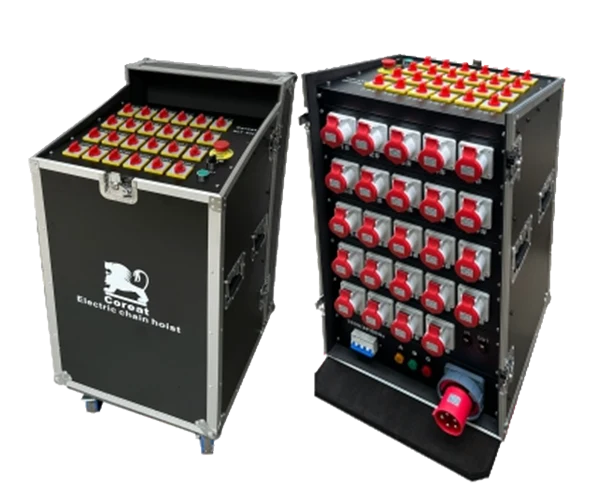
When buyers compare portable vs rack-mount stage hoist controllers, the right answer depends on how the rigging system will be installed, moved, powered, and operated day after day. A touring supplier needs a controller that loads fast, survives transport, and lets technicians deploy quickly. A theater or broadcast studio usually needs a control solution that integrates cleanly into a permanent rack room, supports repeatable workflows, and stays easy for trained staff to maintain.
At Coreat, we build stage hoist controllers for both portable and fixed entertainment rigging systems. This guide explains the differences between portable and rack-mount controllers, where each works best, and how to choose the right format for your next project.
What is a portable stage hoist controller?
A portable stage hoist controller is housed in a carry-ready case, flight case, or rolling cabinet so crews can move it between venues or store it after use. Portable systems are common in concert touring, rental fleets, temporary event structures, hotel ballrooms, houses of worship, and multi-purpose venues where the control point changes from job to job.
Coreat portable controller formats include compact waterproof cases such as the KLT-4P and KLT-8P, larger portable options such as the KLT-12LP, and high-channel rolling cabinet systems such as the KLT-24P.
What is a rack-mount stage hoist controller?
A rack-mount stage hoist controller is designed to be installed inside a standard equipment rack. This format is better suited to permanent venues where power distribution, cable runs, patching, and operating positions are planned in advance. Rack-mount control is common in theaters, opera houses, TV studios, conference centers, and architectural entertainment installations.
Coreat’s rack line includes the KLT-4MP, KLT-8MP, and KLT-12MP 3U rack controllers, which are designed for clean integration with fixed technical infrastructure.
Portable vs rack-mount stage hoist controller: key differences
1. Mobility and deployment speed
Portable controllers are built for transport. If your crews load in and load out on a regular schedule, a waterproof case or rolling cabinet reduces setup friction. Rack-mount controllers are not meant to move often; they perform best where the hoist system remains installed and the operating routine stays consistent.
2. Equipment protection during transport
For touring and rental work, enclosure strength matters almost as much as electrical performance. Portable controllers protect switches, connectors, and internal components from road handling. In permanent venues, that same level of transport protection is usually less important than organized rack integration and easy service access.
3. Cable management and infrastructure
Rack-mount controllers are easier to integrate when the project includes cable trays, patch panels, fixed power distribution, and designated operator positions. Portable controllers work well when cables are deployed only for the duration of a show or event and then packed away again.
4. Operator workflow
Portable controllers suit productions where the operator position changes between rehearsal, setup, and show call. Rack-mount systems are stronger when the venue wants a standard operating location and a repeatable signal path that multiple technicians can follow.
5. Channel count and system scale
Both formats can support multi-hoist operation, but the best packaging changes with scale. For a small to mid-size traveling system, a portable 4, 8, or 12-channel controller is often ideal. For larger permanent systems, 8 or 12-channel rack units and linked control strategies make long-term integration easier. For very large touring or event systems, rolling cabinet controllers such as the KLT-24P can provide high channel counts while staying mobile.
6. Maintenance access
Permanent venues usually prefer rack equipment because electricians and technicians can service it in a controlled room with labeled connections. Portable systems are easier to swap between jobs, but they also need regular inspection of handles, latches, external connectors, and road-worn components. If controller upkeep is a concern, see our stage hoist controller maintenance checklist.
Best choice by application
Theaters and opera houses
Most permanent theaters benefit from rack-mount controllers because the rigging grid, cabling, and operating routines are fixed. A KLT-4MP, KLT-8MP, or KLT-12MP is usually easier to integrate with existing technical rooms and long-term maintenance procedures.
Concert touring and rental companies
Portable controllers are usually the better fit for touring because they are designed for movement, fast deployment, and repeated handling. Compact portable units simplify transport, while rolling cabinet systems support larger channel counts for production-scale rigs.
Broadcast studios
Studios often prefer rack-mount control because they value quiet, organized, repeatable infrastructure. If the studio grid changes often or the controller must move between spaces, a portable format may still make sense, but fixed studios generally choose rack integration.
Hotels, churches, and multi-purpose venues
These projects can go either way. If the rigging system is permanent and operated by in-house staff, rack-mount control is often the cleaner solution. If the room hosts changing event formats or outside production teams, a portable controller may offer more flexibility.
Questions buyers should ask before choosing
- Will the controller stay in one venue, or travel from job to job?
- How many hoists need to be controlled today, and how many may be added later?
- Is there a fixed rack room or control booth already planned?
- Will the operator position stay constant, or move during setup and production?
- Does the project prioritize fast deployment, neat integration, or a balance of both?
If you are also evaluating controller functions, read our stage hoist controller selection guide for a broader view of synchronization, channel count, and application matching.
Final recommendation
The best portable vs rack-mount stage hoist controller decision comes down to workflow. Choose portable when mobility, deployment speed, and repeated transport are central to the job. Choose rack-mount when the venue is permanent, infrastructure is fixed, and the technical team wants clean long-term integration.
If you are planning a theater, concert, studio, or multi-purpose entertainment rigging project, contact Coreat for help matching the right controller format, channel count, and hoist configuration to your application.