

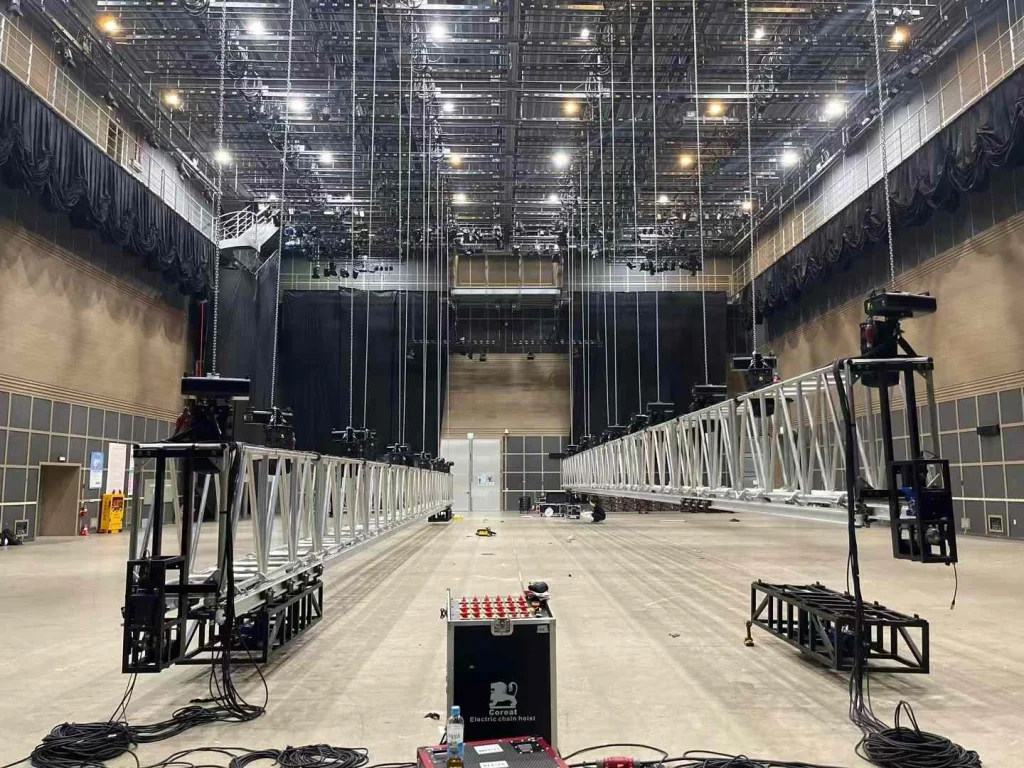
When buyers compare D8 vs D8 Plus stage hoists, they are usually trying to answer a practical project question: what level of suspended-load protection is appropriate for this venue, production, and operating method? The answer affects not only compliance and safety planning, but also product selection, controller design, maintenance expectations, and long-term operating cost.
For theaters, concert venues, broadcast studios, and touring providers, the right choice depends on how the hoist will be used, whether loads remain suspended above people, how often the system operates, and whether the installation is temporary or permanent. Coreat builds both D8 and D8 Plus oriented solutions across its V05, V10, C10, and C20 ranges, so buyers can match the hoist to the real rigging scenario instead of forcing one standard onto every job.
What do D8 and D8 Plus mean in practice?
At a practical buying level, D8 is commonly specified for suspended entertainment loads where the hoist is used for lifting and then the load is not intended to remain above people without additional measures. D8 Plus adds a higher safety concept, typically including a double braking arrangement, for applications where the suspended load strategy demands a stronger margin.
That does not mean one standard is “good” and the other is “bad.” It means the buyer must align the hoist specification with the venue’s risk policy, local standards, production workflow, and the engineer or consultant responsible for the rigging design.
When a D8 stage hoist is often the right fit
A D8 stage hoist can be an efficient choice when the system is designed around controlled lifting operations, clear access restrictions, and defined operating procedures. Many buyers prefer D8 models when they want dependable professional performance without paying for protection features their workflow does not require.
- Temporary lifting during installation or setup periods
- Applications where the load is not intended to remain suspended above occupied areas
- Projects with strong procedural control and secondary safety measures where required
- Buyers prioritizing portability, lower self-weight, and simpler system architecture
Touring companies often look at D8 models first because lighter equipment and easier handling matter on the road. If your team is building a flexible event package, a model such as the Coreat V05 can be attractive because it balances compact size, professional duty, and straightforward deployment.
When D8 Plus is the better buying decision
D8 Plus becomes the stronger choice when the suspended-load strategy is more demanding, the venue wants additional protection built into the hoist itself, or the project will be reviewed by stakeholders who expect a double-brake configuration as part of the specification. In many real-world entertainment projects, buyers choose D8 Plus not because it is fashionable, but because it reduces ambiguity during procurement and operation.
- Permanent installations in theaters, auditoriums, and broadcast studios
- Heavy scenic elements, speaker clusters, LED structures, or trusses with higher consequence of failure
- High-duty venues running frequent shows and repeat lift cycles
- Projects where consultants, venue owners, or insurers prefer a higher built-in safety margin
For example, Coreat’s Plus versions in the V and C series use a double braking system, giving buyers a clearer route when their technical brief calls for a more conservative suspended-load approach.
How D8 and D8 Plus map across the Coreat range
V05 / V05 Plus
The V05 and V05 Plus are strong candidates for concert touring, smaller theaters, hotel ballrooms, club rigs, and general live-event production. The standard V05 D8 gives a capable 500 kg package with low self-weight, while the V05 Plus adds double braking for buyers who want more protection without moving to a larger hoist class.
V10 / V10 Plus
The V10 and V10 Plus step up to 1,000 kg capacity for heavier touring trusses, arena systems, and permanent theatrical rigging. Buyers comparing D8 vs D8 Plus at this level are often balancing capacity with venue policy. If the project includes heavier overhead loads and intensive show schedules, the V10 Plus usually makes the specification conversation easier.
C10 / C10 Plus
The C10 and C10 Plus are positioned for fixed installations. That makes the D8 Plus decision especially relevant, because permanent systems are reviewed not only for lifting performance but also for what happens when the hoist sits overhead for long periods. If your venue is a theater, conference hall, or studio building a permanent grid, the C10 Plus is often the safer long-term purchasing choice.
C20 D8 Plus
The C20 is Coreat’s 2,000 kg heavy-load solution and is built for projects where buyers already know a standard-range hoist is not enough. In practice, this is where D8 Plus thinking becomes even more important, because load consequence increases with system scale. Large scenic structures, major cultural venues, and specialty entertainment architecture often start in this category.
Questions buyers should ask before specifying either standard
- Will the load ever remain suspended above performers, crew, or audience areas?
- Is the project temporary, touring, semi-permanent, or fully permanent?
- What does the venue consultant or structural engineer require?
- How many duty cycles will the system run per week?
- Does the hoist need to integrate with a multi-unit controller such as Coreat’s KLT controller range?
- Would a higher built-in braking margin simplify approval and procurement?
If you are still mapping the complete lifting system, Coreat’s stage hoist system design guide and controller selection guide are useful next reads.
Common mistakes in D8 vs D8 Plus procurement
The most common mistake is buying only on price or rated capacity. Two 1,000 kg hoists may look similar on a quote sheet, but they are not equal if the venue expects different operating methods or safety philosophy. Another mistake is choosing a touring-oriented hoist for a permanent venue simply because it is popular, or specifying an oversized model when a lighter, easier-to-handle option would perform better.
Buyers also underestimate documentation. A better supplier should be able to explain not only lifting capacity, but also braking architecture, chain specification, protection rating, maintenance expectations, and controller compatibility.
Final recommendation
If your application is mobile, controlled, and operationally simple, a D8 model may be the correct commercial and technical fit. If the venue is permanent, the suspended loads are more critical, or the spec demands a stronger built-in safety margin, D8 Plus is usually the better decision.
Coreat manufactures both touring-oriented and permanent-installation stage hoists, with matching control systems and direct factory support for international buyers. If you want help comparing V05, V10, C10, and C20 options for your project, contact the Coreat team for a recommendation based on load, venue type, and operating method.