

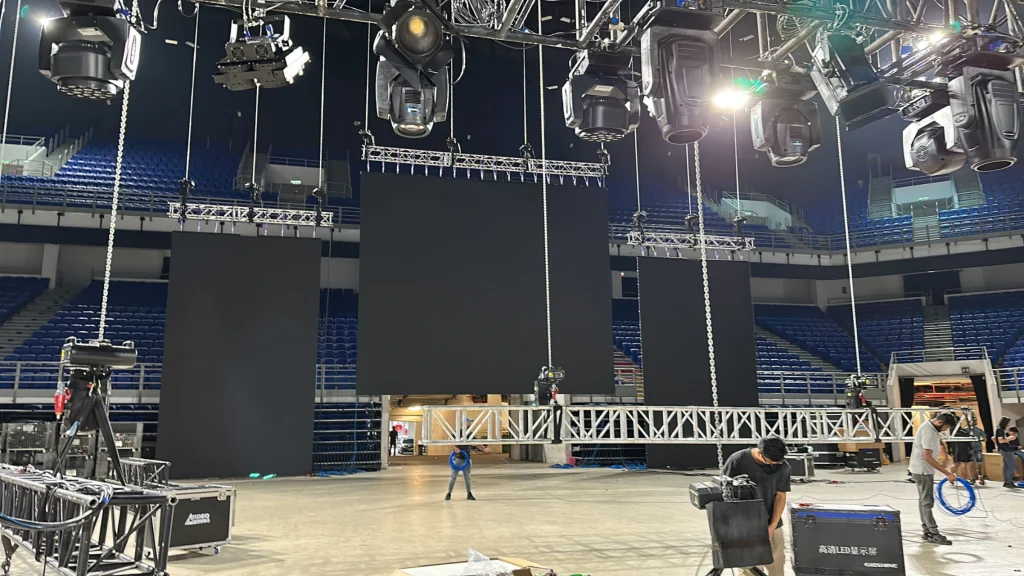
Choosing a stage hoist for LED walls, lighting trusses, and scenic elements is not only a matter of lifting capacity. Buyers also need to think about load distribution, pick-point quantity, duty cycle, installation style, controller coordination, and whether the system will live in a touring package or a permanent venue.
In practice, many purchasing mistakes happen because a project team asks, “Which hoist model should we buy?” before defining what is actually being lifted. A compact LED header, a touring lighting truss, and a heavy scenic element may all use electric chain hoists, but they do not create the same rigging requirements. Coreat’s hoist range gives buyers several clear paths, from the road-friendly V05 to the high-capacity C20.
Why application-first selection matters
The most reliable way to specify a stage hoist is to begin with the object being lifted and the environment around it. The correct hoist is a system decision, not just a product decision. Before you compare model numbers, define:
- The total suspended load, including structure, connectors, and accessories
- The number of hoists and pick points required
- Whether lifts will be synchronized
- The frequency of operation
- Whether the rig is touring, temporary, or permanent
- Whether the load will remain overhead for long periods
This is also where a coordinated controller matters. If the project uses multiple hoists for the same object, the buyer should evaluate the hoist and controller together, not as separate purchases. Coreat’s KLT hoist controller range is designed to work directly with its stage hoists for synchronized operation and clean project integration.
Stage hoists for LED walls
LED wall structures often look lighter on paper than they feel in real engineering terms. That is because buyers need to consider not only panel weight, but also the supporting frame, rigging hardware, cable management, service access, and the consequence of uneven lifting. If the wall is built from multiple sections, synchronized lifting and stable pick-point planning become critical.
For LED wall projects, buyers should focus on uniform load sharing across all pick points, controller compatibility for multi-hoist synchronization, permanent versus touring installation style, required lifting speed, and venue clearance for chain bags and service access.
A touring LED wall may favor a lighter, easier-to-handle hoist such as the V05, while a larger fixed screen structure in a theater or studio may justify a C10 or heavier-duty configuration.
Stage hoists for lighting trusses
Lighting truss applications vary from small club systems to arena-scale mother grids. Buyers often underestimate the importance of self-weight, because crews may need to transport, climb, install, and service these systems repeatedly. That is why a touring production company may reject an oversized hoist even if it has more capacity on paper.
For many concert and event truss packages, the V05 is the practical workhorse because it balances professional lifting performance with portability. If the loads are heavier, the spans are larger, or the touring package includes substantial speaker or video weight, the V10 becomes the more appropriate step up.
Stage hoists for scenic elements and heavier show structures
Scenic loads can be the most deceptive category of all. A scenic piece may not only be heavy, but also irregular in shape, sensitive to tilt, and integrated with automation, masking, or performer interaction. In these cases, the hoist choice should be conservative and closely coordinated with the designer or engineer responsible for the production system.
Permanent venues lifting scenic elements often look first at the C10 / C10 Plus, because the 1,000 kg fixed-installation platform fits many theaters, auditoriums, conference venues, and studio builds. When the project moves into heavier scenic structures or major venue infrastructure, the C20 is the model buyers should review first.
How to match the Coreat hoist range to the application
V05 / V05 Plus
Best for touring-friendly lighting trusses, flexible live-event packages, compact LED structures, clubs, hotel ballrooms, and multipurpose entertainment venues that need professional rigging without excessive self-weight.
V10 / V10 Plus
Best for heavier touring trusses, arena systems, larger speaker and video loads, and venues that need more headroom in the specification without moving directly to a permanent heavy-load product.
C10 / C10 Plus
Best for fixed theater, auditorium, conference, and studio installations where 1,000 kg class lifting is required and long-term reliability matters more than road portability.
C20
Best for unusually heavy scenic elements, large venue structures, and projects where the suspended load exceeds the practical upper range of standard 1-ton entertainment hoists.
Do not forget the controller
If two or more hoists are lifting the same object, the controller becomes part of the safety and performance conversation. Buyers comparing hoists for LED walls or long trusses should review controller channel count, enclosure style, synchronization requirements, and future expansion at the same time. Coreat’s controller channel guide and controller selection guide are helpful references if you are still sizing the control system.
A practical buyer checklist
- Define the real working load, not just the headline object weight
- Confirm the number of pick points and whether lifting must be synchronized
- Match touring projects to manageable hoist size and weight
- Match permanent venues to long-term installation priorities
- Choose the controller at the same time as the hoists
- Ask the supplier about braking configuration, IP rating, chain specification, and overload protection
If your team is still at the planning stage, Coreat’s stage hoist system design guide is a useful next step before final procurement.
Final recommendation
The right stage hoist for an LED wall, lighting truss, or scenic element depends on the object, the venue, and the operating method. Touring jobs usually reward compactness and handling efficiency. Permanent venues usually reward higher structural margin and specification clarity. The best buying decision comes from matching the load case to the correct hoist family instead of choosing by capacity alone.
Coreat supplies stage electric chain hoists and matching controllers for theaters, concert touring, studios, and entertainment venues worldwide. If you want a model recommendation for your LED wall, truss, or scenic lifting project, contact Coreat with your load, pick-point, and venue details.